
Where Marbella is, where it stops, and why the boundary decides more than you think
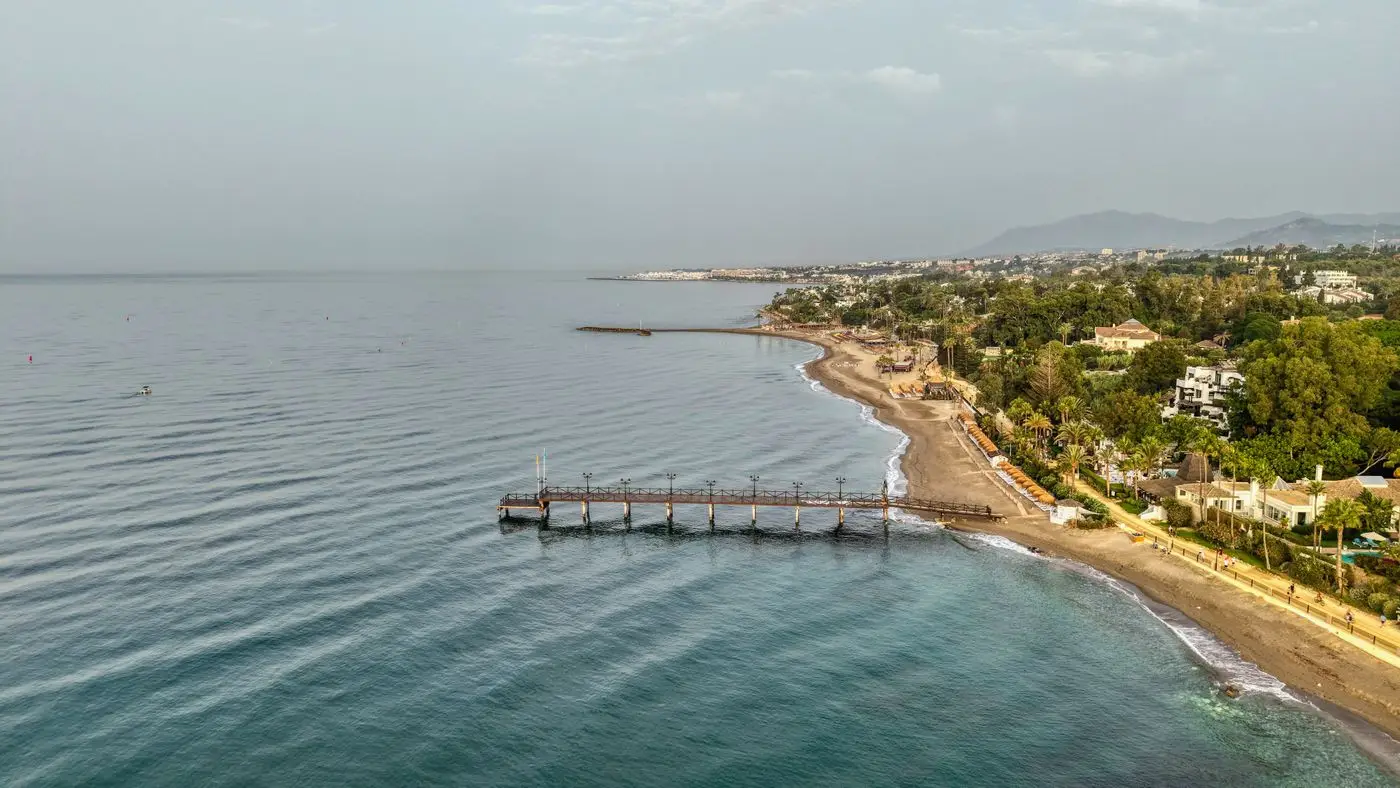
Marbella is a municipality on the southern coast of Spain, in the province of Málaga, in the autonomous region of Andalusia. It sits roughly forty minutes west of Málaga airport along the coast.
That is the short answer, and it is the one most pages give. The longer answer is the useful one, because Marbella stops somewhere, and where it stops changes the rules that apply to a property.
The six neighbours
Marbella’s municipal boundary runs:
- North — Istán and Ojén, both inland mountain municipalities
- East — Mijas and Fuengirola
- West — Estepona and Benahavís
- South — the Mediterranean
The coastline of the municipality runs roughly 27 kilometres. Everything from San Pedro de Alcántara in the west to Cabopino in the east is Marbella. West of San Pedro, you are in Estepona. East of Cabopino, you are in Mijas. Inland behind the Golden Mile you cross into Benahavís sooner than most people expect.
Why the boundary is not a technicality
Three things follow the municipality and change the moment you cross the line.
The town hall that issues licences. The works licence and the licence of first occupation — the document confirming the finished building matches what was permitted — come from the municipality the property sits in. A Marbella licence means nothing for a house in Benahavís.
The general plan. This is the sharpest difference on this coast, because Marbella’s planning history is unusual. The Supreme Court annulled the municipality’s 2010 general plan in 2015, returning it to a plan approved in 1986; a replacement, the PGOM, has been working through approval, and the detailed instrument that settles matters at the level of an individual plot comes later still.
That history is Marbella’s. It does not apply in Estepona, Mijas, Fuengirola or Benahavís, each of which has its own plan and its own town hall. We see the mistake made in both directions: people worry about something that does not affect their property, or relax about something they have not checked.
IBI, the annual property tax. Each municipality sets it within statutory limits. Two comparable houses either side of the boundary can carry different annual bills for no other reason.
What does not change
This is the part that reassures people, and it is worth being precise about, because it is most of the transaction.
| Set by | Same across the coast? | |
|---|---|---|
| Transfer tax (ITP), stamp duty (AJD) | Andalusia | Yes |
| Tourist letting registration | Andalusia | Yes |
| NIE, notary, Land Registry, Cadastre | Spain | Yes |
| Non-resident tax obligations | Spain | Yes |
| Works licence, licence of first occupation | Municipality | No |
| General plan | Municipality | No |
| IBI, local charges | Municipality | No |
So the paperwork you file is largely the same wherever you buy on this stretch. The office that decides what your building is allowed to be is not.
The municipalities, west to east
Casares and Manilva — west of Estepona, lower density, further from the airport. Beyond where most Marbella buyers look.
Estepona — borders Marbella to the west. Its own town centre, its own general plan, and a larger share of new build than the coast further east. Covered separately.
Benahavís — inland between Marbella and Estepona, in the hills. Small permanent population, housing stock weighted heavily toward large villas and gated estates. La Zagaleta is here, not in Marbella, despite how it is marketed. Covered separately.
Marbella — 27 km of coast: San Pedro de Alcántara, Nueva Andalucía, Puerto Banús, the Golden Mile, the old town, the hillside urbanisations, and the eastern beaches out to Cabopino.
Istán and Ojén — inland mountain villages north of Marbella. Small property markets; realistic mainly for buyers specifically looking for a rural inland house.
Mijas — borders Marbella to the east. Three quite different parts: Mijas Pueblo up in the hills, Mijas Costa along the sea, and La Cala de Mijas as its own coastal town. A large, established international resident population.
Fuengirola — also borders Marbella to the east. Denser, more apartment stock, a year-round town rather than a resort strip, and a different price level from Marbella.
Further east (Benalmádena, Torremolinos, Málaga city) the market changes character again, and buyers looking there are usually looking for something different from buyers looking at Marbella.
The inland neighbours nobody mentions
Marbella’s coastal neighbours get all the attention. Its northern ones, Istán and Ojén, barely appear in property writing, and they are worth knowing for two reasons.
They are close. Ojén sits in the hills directly behind Marbella, and Istán behind the Golden Mile. From the coast they look remote; by road they are not.
And they explain something about the coast: the mountain barrier behind Marbella is why the developed strip is as narrow as it is. There is no gentle plain inland here, which is why the coastal corridor filled up, why the hillside urbanisations climb, and why land that looks buildable on a map often is not.
If someone offers you a plot “just above Marbella” with development potential, the first question is which municipality it is in, and the second is how the land is classified there.
Western Costa del Sol as an administrative thing
The stretch from Torremolinos to Manilva is commonly called the Costa del Sol Occidental, and it is not only a marketing phrase. The municipalities along it co-operate through a mancomunidad, an association of municipalities, for shared services.
The one that matters most to a homeowner is water. The western coast draws largely on a shared reservoir system inland, and Andalusia has had drought restrictions in recent years. A property with a garden, a pool and irrigation is exposed to decisions taken at that level, not at the level of your community of owners.
Ask two things about any property with significant outdoor space: what the water supply is. Mains, shared, or a private borehole with its own permit history, and whether the urbanisation has its own storage or treatment arrangements.
How to establish the municipality of a specific property
The listing is not evidence. Three sources are:
The nota simple. It states the municipality of the property. This is the authoritative answer and it takes minutes to obtain.
The cadastral record. The Cadastre states the municipality alongside the reference and the surface area. If it disagrees with the nota simple, that is a separate problem worth resolving before anything else.
The IBI receipt. It comes from a named town hall. Whichever town hall’s name is on it is the municipality, and it also tells you what the annual bill actually is, rather than what the seller remembers it being.
Any of the three settles the question. The reason to bother is that the answer determines which town hall issues the licences, which general plan applies to the plot and which annual bill arrives.
Where the road and the rail actually go
Two facts that shape daily life more than any municipal boundary:
Two roads run the coast. The A-7 is the free coastal road, slower and with local access; the AP-7 is the toll motorway running parallel, and it is the difference between a predictable journey and an August one. Whether a property has convenient access to the AP-7 is worth checking on a map.
The rail stops at Fuengirola. The suburban line from Málaga and the airport terminates there. Everything west — Mijas Costa, Marbella, Benahavís, Estepona, Manilva — has no rail service at all. That single fact does more to determine whether you need a car than any other feature of this coast, and it is frequently discovered after a purchase rather than before.
The practical rule
Before you apply anything you have read to a specific property, confirm the municipality on the nota simple. Not on the listing, not on the portal’s location filter, not on the agent’s description. Properties in Benahavís, Estepona and Mijas are routinely marketed under Marbella addresses, and that is not usually deception. Marbella is the recognised name for the whole area.
But it determines which town hall issued the licence you are about to rely on.
Frequently asked questions
Where is Marbella?
On Spain’s southern coast, in the province of Málaga, in the autonomous region of Andalusia. Roughly forty minutes west of Málaga airport. The municipality covers about 27 kilometres of coastline, from San Pedro de Alcántara in the west to Cabopino in the east.
Which municipalities border Marbella?
Istán and Ojén to the north, Mijas and Fuengirola to the east, Estepona and Benahavís to the west, and the Mediterranean to the south.
Why does the municipality matter when buying?
Because three things follow it: the town hall that issues the works licence and the licence of first occupation, the general plan that governs what the plot may do, and IBI, the annual property tax. All three change at the boundary.
Does Marbella’s planning situation affect neighbouring towns?
No. The 2015 annulment of Marbella’s 2010 general plan and the PGOM that has been replacing it concern the municipality of Marbella. Estepona, Benahavís, Mijas and Fuengirola each have their own plan administered by their own town hall.
Is the purchase tax different from town to town?
No. Transfer tax and stamp duty are set by Andalusia, so they are the same across the whole coast. What differs municipally is IBI and the local charges.
Are the tourist letting rules different in each town?
The registration itself is Andalusian — a declaration to the regional tourism register producing a number that must appear in advertising, so it is the same across these municipalities. What can differ is what the community of owners’ statutes permit, and that is a building-by-building question rather than a municipal one.
How do I find out which municipality a property is actually in?
The nota simple from the Land Registry states it. That is the answer to rely on rather than the listing, which may well describe a Benahavís or Estepona property as “Marbella”. A third source is the IBI receipt: it comes from a named town hall, and it also tells you what the annual bill actually is rather than what the seller remembers it being.
Is Fuengirola part of Marbella?
No. Fuengirola is a separate municipality that borders Marbella to the east, with its own town hall, its own plan and its own local taxes. So is Mijas, which lies between them along much of the boundary.
Which municipalities border Marbella inland?
Istán and Ojén, both mountain municipalities directly behind the coast. They rarely appear in property writing but they explain the shape of the coast: the mountain barrier is why the developed strip is narrow, why the hillside urbanisations climb, and why land that looks buildable on a map often is not.
Is water supply a municipal question on the Costa del Sol?
Partly. The western coast draws largely on a shared reservoir system inland and the municipalities co-operate through a mancomunidad for shared services. Andalusia has had drought restrictions in recent years, so a property with a garden, pool and irrigation is exposed to decisions taken above the level of your community of owners.
What is the difference between the A-7 and the AP-7?
The A-7 is the free coastal road, slower and with local access; the AP-7 is the toll motorway running parallel to it. In practice it is the difference between a predictable journey and an August one, so whether a property has convenient access to the AP-7 is worth checking on a map before committing.
How far west does the train go?
It stops at Fuengirola. The suburban line from Málaga and the airport terminates there, so Mijas Costa, Marbella, Benahavís, Estepona and Manilva have no rail service at all. That fact determines whether you need a car more than any municipal boundary does.
Sources
- Ayuntamiento de Marbella (checked 2026-08-03)
- Ayuntamiento de Marbella: Urbanismo, Plan General (checked 2026-08-03)
- Agencia Tributaria de Andalucía: transfer tax and stamp duty (checked 2026-08-03)
- Junta de Andalucía: tourist accommodation register (checked 2026-08-03)
- Colegio de Registradores: Land Registry of Spain (checked 2026-08-03)